


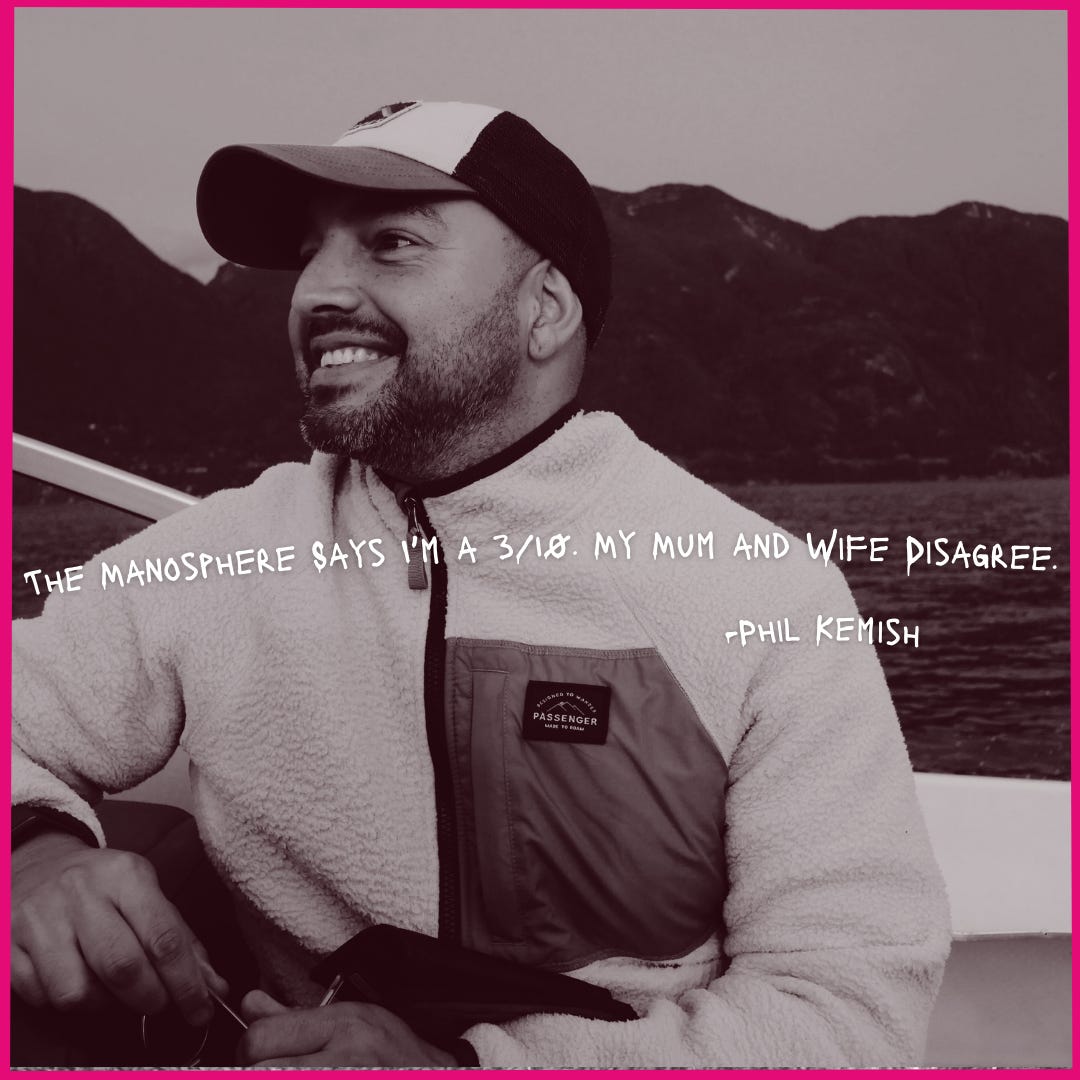
I watched the Louis Theroux Manosphere documentary this weekend.
I watched it with my Mum.
She sat next to me on the sofa, quietly taking it all in. Not angry. Just genuinely shocked. Not at the men selling this stuff. At the fact that millions of young men are buying it. That this world exists, is enormous, and until now had been completely invisible to her.
To be honest, even knowing what I know, a lot of it was invisible to me too.
By the metrics of the manosphere, I am a catastrophic failure of a man.
I’m probably a solid 3 out of 10 on whatever value matrix these guys are running. My jawline is heading south. My waistline is going with it. I don’t have a Lamborghini. I have what you might generously describe as complex emotional needs. I cry at films. I love Bridgerton. I talk about my feelings. I have days where I struggle and I say so out loud to the people I love.
I also have a wife who is, by any measure, a 10 out of 10.
And she doesn’t love me despite those things. She loves me because of them. She has told me, more than once, in more than one way, that my willingness to be soft, to be vulnerable, to show up emotionally present rather than armoured up and performing, is exactly what makes her feel safe. That’s the foundation our relationship is built on.
So I watched this documentary and I thought: what are these men actually selling? And why are so many young men buying it?
The psychology of selling pain.
Here’s something worth understanding. Because it’s much older than the manosphere.
Every one of us, at some point, has bought into this. Felt insecure about something — our body, our success, our relationships and reached for something that promised to fix it. The self-help book. The course. The programme. The supplement. We all want to grow. That impulse is healthy and human.
The problem is what happens when people weaponise that impulse.
The playbook is simple: find the fear, amplify it, sell the cure. You’re not fit enough, here’s the stack. You’re not rich enough, here’s the course. You’re not man enough, here’s the community. These men aren’t selling fitness or money or status. They’re selling relief from pain and insecurities. And they’re very good at it.
We’ve always had men selling shortcuts to other men. Get rich quick. Get fit fast. Get the girl. That dream has always been for sale. What’s changed is the reach and the speed. What used to travel by late night infomercial now lands in a teenage boy’s feed before he’s finished breakfast, optimised by an algorithm that has learned exactly which fear to poke.
The difference now is the scale. And the damage that comes with it.
Back to the men themselves.
I get it. I really do.
Men are struggling. The stats are real. Isolation, mental health, falling behind in education, a loss of purpose and identity. The old scripts for what it means to be a man have been ripped up without anything coherent put in their place. And into that vacuum walks someone with a camera, a six pack, and a simple message: you’re not the problem. The world is. I can fix you.
These aren’t confident men. They’re performing confidence. There’s a difference, and the camera catches it even when they don’t.
The tragedy isn’t that these men are bad. It’s that they’re in pain and they found a way to sell that pain as a product. And millions of young men, who are also in pain, are buying it because they’re desperate.
The numbers are hard to ignore. According to Movember’s global research, nearly two thirds of young men aged 16-25 regularly engage with masculinity influencers online. Those same young men report higher levels of psychological distress, are less likely to prioritise their mental health, and are more likely to engage in risky behaviours. And according to Equimundo’s State of American Men report, two thirds of young men feel that no one really knows them. That’s not a crisis of masculinity. That’s a crisis of connection.
I think about my two teenage nephews growing up online, algorithms already learning their insecurities, content finding them before they even know what they’re looking for, and I find that genuinely terrifying.

What they’re actually selling.
The courses, the supplements, the membership communities. Those are almost incidental. What these men are actually selling is identity. Belonging. A story about who you are, why your life looks the way it does, and who’s to blame for it.
That sells because identity is exactly what a lost, isolated young man is desperate for.
But the identity on offer is a cage. It tells you that softness is weakness. That emotion is failure. That the measure of a man is his jawline, his bank balance, his ability to dominate. That the women in your life, your mum, your sister, your partner, are obstacles or objectives. Never allies.
I think about my own life and I know with complete certainty that is wrong.
This is exactly one of the reasons I started Skin in the Game. To build something that goes in the opposite direction. A community for men who want to lead better, live fuller, and play bigger without losing themselves or the people they love in the process. Not a red pill. Not a quick fix. The real work.
What these men actually need.
This is going to sound reductive. I mean it sincerely.
I think most of them just need a hug.
Not because they’re weak. Because they’re human.
Because underneath every man performing dominance online is a person who learned somewhere along the way that needing things from people was dangerous. That asking for help was failure. That softness would get you hurt.
And instead of healing that, the manosphere monetises it. Fuels it. Amplifies it and feeds it back to them as identity. And in doing so it’s creating a generation of young men whose role models are performing pain as power.
That’s not a movement. That’s a crisis.
A final thought. Maybe instead of the red pill, try listening to the women already in your life.
Instead of paying a stranger on the internet to tell you how to be a man, what if you asked your mum? Your sister? Your partner? The women who actually know you, who have watched you your whole life, who want you to be well?
I know what mine would say.
Stop performing. Start feeling. The people who love you aren’t waiting for you to be dominant. They’re waiting for you to show up.
If you’re looking for a quick fix, a shortcut to the man you want to be, I understand the appeal. We live in a world that sells shortcuts to everything. But the work that actually changes men’s lives doesn’t come in a course or a supplement stack. It looks like therapy. Honest friendships. A partner you let in. A relationship with your own fear that’s curious rather than hostile.
It looks like finding a role model who has the success and the drive but also shows up for his friends, his family, his partner. Who is willing to be honest about the hard stuff. Who measures himself by the depth of his relationships, not the size of his yacht.
Do the slow work. The deep work. That’s how you get out of the matrix. Not into a smaller, lonelier version of it, but into something real.
You deserve a bigger, better life.
If you haven’t watched it yet, Louis Theroux: Inside the Manosphere is on Netflix now. Watch it. Then have a conversation with the people around you about what you saw.
You can watch the Louis Theroux Manosphere trailer below:
That conversation is probably more valuable than anything in the manosphere ever will be.
Skin in the Game is where I share the real journey. The lessons from building, leading, and figuring it out without losing yourself and becoming a better man along the way. If this landed, subscribe below.
Your work is a breath of fresh air, and I cannot wait to read more of your work soon.